Velodrome Los Angeles: How to Photograph Track Cycling in Carson
The indoor track in Carson is the velodrome Los Angeles photographers use to see elite track cycling up close. A guide to panning, light and working around training camps.
The one velodrome Los Angeles has
If you are looking for a velodrome, Los Angeles has a serious one: the VELO Sports Center in Carson, an indoor wooden track on the same campus as the soccer stadium. Its steeply banked 250-meter boards are built for international competition, and national teams from around the world use it for training camps, especially in the months before major championships.
For a photographer, that means a chance to see world-class riders working at close range, often without a crowd. Training sessions are long, repetitive and predictable, which is exactly what you want when you are learning to pan. A rider who does twenty identical efforts gives you twenty chances at the same frame.
Access is not automatic. Contact the facility and, for a visiting team, the team's own staff or media officer. Explain what you want to shoot and where you want to stand, and expect to work around their schedule, not yours.
Panning on the banking
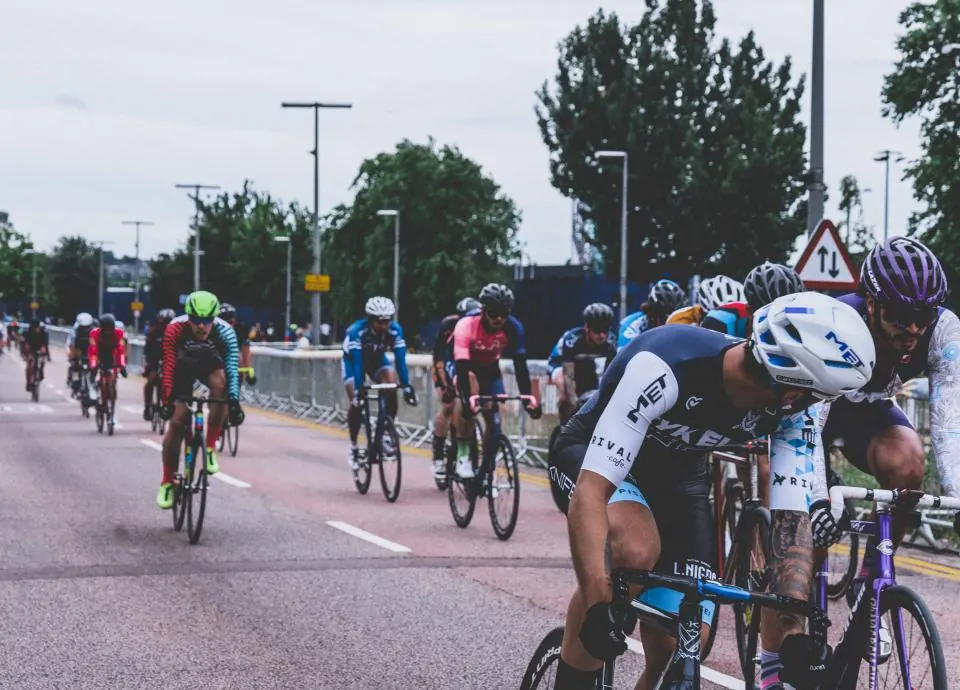
Panning is the signature technique of track cycling photography. Set the shutter between 1/30s and 1/60s, track the rider smoothly through the frame and press the shutter mid-swing, following through after the click. The rider stays sharp while the boards and the background streak into lines of color.
Banked turns make this harder and better. The rider is leaning hard, the bike is tilted and the track surface rises behind them. Shooting from the infield at the apex of a turn, you get the full lean with the banking as a graphic backdrop. Shooting from the top of the stands, looking down the straight, you get riders stacked in a paceline.
Start at 1/60s to get a feel for the speed, then slow down. At 1/30s and slower the keepers get rarer but more dramatic. Use continuous autofocus with a small cluster of points, and shoot short bursts so at least one frame lands sharp.
A rider who does twenty identical efforts gives you twenty chances at the same frame.
Indoor light and color
Velodromes are lit for riders and broadcast, not for still photographers. Expect mixed light from overhead fixtures and windows, and possible flicker at high shutter speeds. Panning at slow shutter speeds sidesteps most flicker issues, but freeze-frame shots at 1/1000s may show banding; enable your camera's anti-flicker mode if it has one.
Set a custom white balance from the wooden surface or a gray card. The warm boards and colorful team kits look great when neutral, and they turn muddy fast if the camera guesses. Shoot raw and keep exposure consistent from frame to frame so the sequence edits cleanly.
When freezing action, a fast mid-range zoom like a 24-70mm f/2.8 or a 70-200mm f/2.8 at ISO 3200 to 6400 is typical. Faces under helmets and visors benefit from catching riders as they come off the banking into the brighter straight.
Telling the story of a training camp
Training camps offer more than racing shots. Mechanics swapping gearing in the infield, riders on rollers before an effort, a coach with a stopwatch at the rail, a rider collapsed on the infield grass after a flying lap. These quieter frames give a camp gallery its rhythm.
Use a wide lens, 16-35mm or 24mm, close to the rail when allowed. A rider passing a meter away at full speed, blurred at 1/15s against a sharp crowd barrier, shows speed in a way a telephoto cannot.
Stay off the track and out of the riders' line at all times. Riders on fixed-gear bikes cannot brake. The velodrome in Los Angeles is a working training venue, and the photographers who get invited back are the ones nobody notices.
Editing a panning sequence
Panning produces a lot of near misses. Cull ruthlessly: keep only frames where the rider's face or helmet and the front of the bike are sharp. A slight blur on the legs and wheels is fine, even welcome, because it sells the speed.
Sequence a set from slow to fast, with the most abstract frames, riders as streaks of color, near the end. A few tightly cropped frozen frames of faces under effort hold the set together and remind the viewer there are people inside the blur.