Photographing Florsheim Shoes and Heritage Wingtips Up Close
Florsheim shoes and other classic American dress shoes reward patience: raking light across brogue punching, clean macro detail and still life sets that feel built rather than bought.
Why heritage dress shoes are a still life problem
Florsheim shoes sit in a category of men's footwear where the selling points are small: the punched medallion on a wingtip toe, the welt stitching, the burnish on a cap toe, the grain of a calfskin upper. A sneaker can be sold with an action shot. A brogue is sold with a close look, which makes this kind of work closer to jewelry or watch photography than to a lookbook.
That changes the whole approach. Instead of chasing movement, you control everything: the angle of the shoe, the direction of the light, the height of the camera, the texture underneath. Most of the time on set goes into small adjustments of a few millimeters, and the best frames look calm because nothing in them was left to chance.
Lighting leather, punching and stitching
Polished leather behaves like a curved mirror. A large softbox or a scrim placed close and slightly above the shoe gives a long, even highlight down the vamp that reads as shine without blowing out. Feather the light so the gradient falls off toward the heel, and the shoe gains shape instantly.
Detail comes from a second, harder light. A small strobe with a grid, kept low and nearly parallel to the surface, rakes across broguing and stitch lines so every hole and thread throws a tiny shadow. Pull it back a stop at a time until the texture is visible but the leather still looks smooth. A black flag on the opposite side keeps the dark side dark, which is what makes cordovan and oxblood finishes look rich instead of muddy.
For brown and burgundy leathers, check color against a gray card under the exact lighting you will use. Warm modeling lamps can trick your eye on set, and color-accurate leather is the one thing a heritage shoe client will notice first.
A brogue is sold with a close look, so every millimeter of light matters more than any amount of movement.
Macro detail and focus stacking
A 100mm macro lens on a full-frame body is the standard tool. It lets you stand far enough back to light properly while filling the frame with a toe cap or a heel stack. At close distances, though, depth of field shrinks to a few millimeters even at f/11, and stopping down further brings diffraction softness.
Focus stacking solves this. Lock the camera on a geared head, tether to a laptop, and shoot ten to thirty frames while stepping focus from the front of the welt to the back of the counter. Stack in Helicon Focus or Photoshop, then check edges where laces and eyelets overlap, because that is where stacking artifacts show up. For full-shoe hero shots, a 90mm tilt-shift can place the plane of focus along the length of the shoe and save the stack entirely.
Prep the product before it gets near the lens. Remove stickers and tissue, wipe with a microfiber cloth, use cotton gloves, and keep a can of compressed air nearby. At macro scale, a single fiber on the toe cap becomes a retouching job.
Building still life sets that suit classic footwear
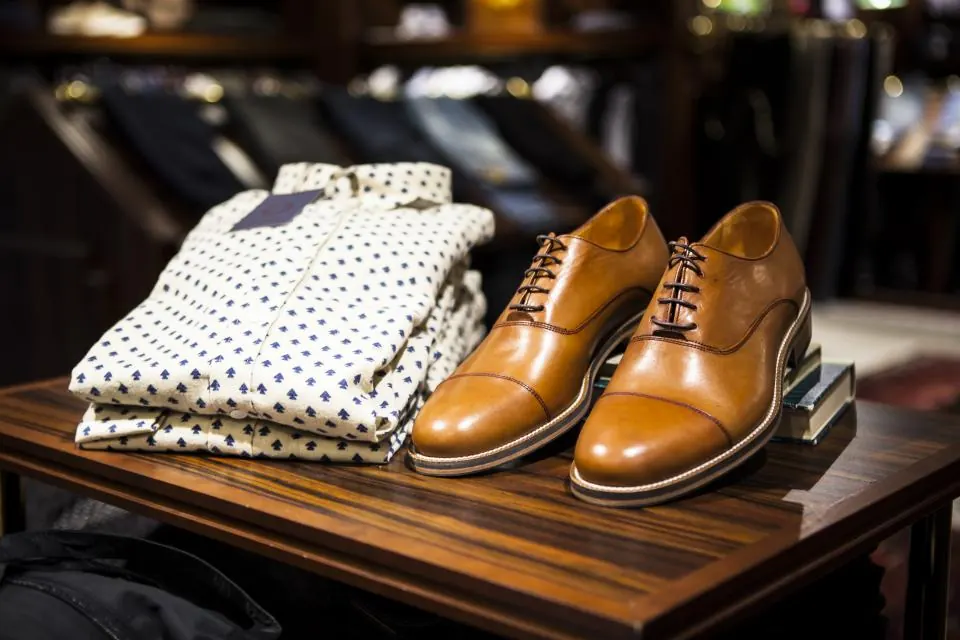
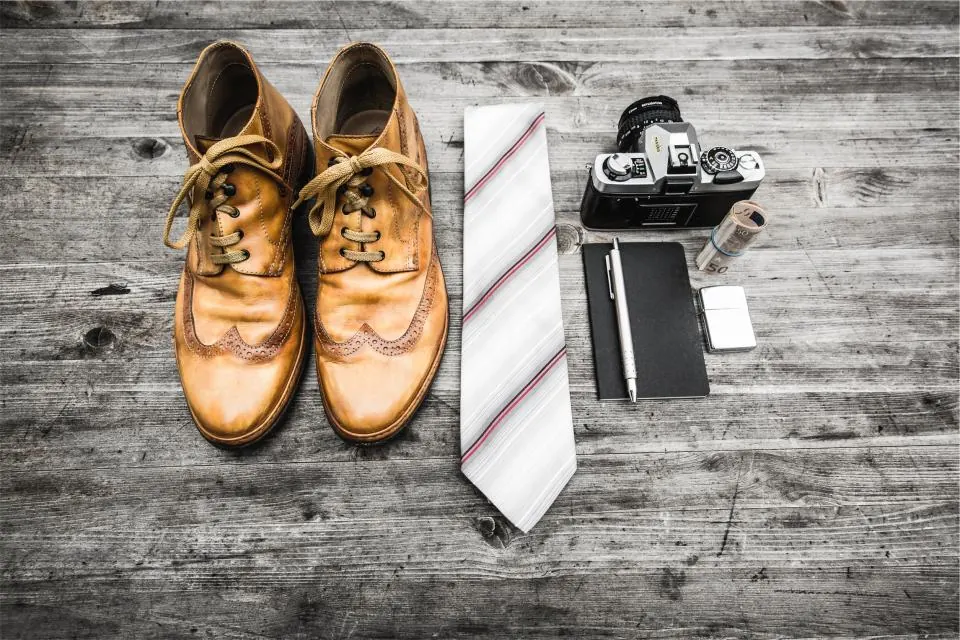
Heritage men's shoes look right on surfaces with some history: walnut boards, slate, raw linen, worn leather desk pads, or a sheet of painted paper with a subtle mottle. Prop houses in Los Angeles and the vintage dealers along the Arts District stock exactly this kind of material, and a single good surface can carry a whole set of images.
Keep props in a supporting role. A shoe tree, a horsehair brush, a folded pocket square or a tin of wax tells the story of care and craft without stealing focus. Pair shoes so the second one sits slightly behind and angled, and you get depth without clutter.
Shoot a consistent set of angles for every style, often a three-quarter front, a pure profile, a sole shot and a top-down pair, plus one or two detail crops. Whether the subject is Florsheim shoes or a small independent bootmaker, that repeatability is what lets a catalog of dress shoes feel like one considered body of work.