Car Window Photography: The Car as Frame for an Indie Magazine
Car window photography turns glass, reflections and movement into a frame within the frame. Here's how to approach it for an independent print story in Los Angeles.
Why the car works as a frame
In Los Angeles, a lot of life is seen through glass. Car window photography uses that fact: the window frame crops the world into a rectangle, the glass adds reflections, and the motion of the car gives every scene a sense of passing. For an indie print magazine, it's a natural way to tell a story about the city without a single location.
There are two directions to work in. Shooting out, from inside the car toward the street, puts the viewer in the passenger seat. Shooting in, from outside toward a driver or passenger, turns the car into a portrait studio with a built-in frame and a layer of reflected city over the face.
Working with reflections
Reflections are the material here, not a problem to remove. A polarizer lets you control them: rotate it to cut the glare completely, or back it off to let a palm tree or a neon sign ghost over your subject's face. Check the effect at each angle, since polarizers work strongest at around 35 degrees to the glass.
When shooting in, park so the background behind you is interesting, because that's what will appear in the glass. A street of signs in Koreatown or a row of palms on a Silver Lake hill gives layers; a blank wall gives nothing. Expose for the face inside and let the reflections sit at whatever density they land.
Tinted rear windows act as built-in ND filters and can make a passenger glow against a darker interior. Front windows are usually clearer.
In this city the windshield is the most common frame there is. The trick is to treat the glass as part of the picture.
Motion and shutter speed
Shooting out of a moving car, shutter speed decides the mood. At 1/500s the street freezes into a crisp postcard; at 1/30s or 1/15s, roadside objects streak while distant hills stay sharp. Brace the camera against the door frame, never against the glass, which carries vibration from the road.
Always have a dedicated driver. Whoever shoots should not be behind the wheel, and for shots of a driver from a following car, a camera car with a second driver and agreed routes on quiet streets is the only safe way to work. Freeways are best left to permitted productions.
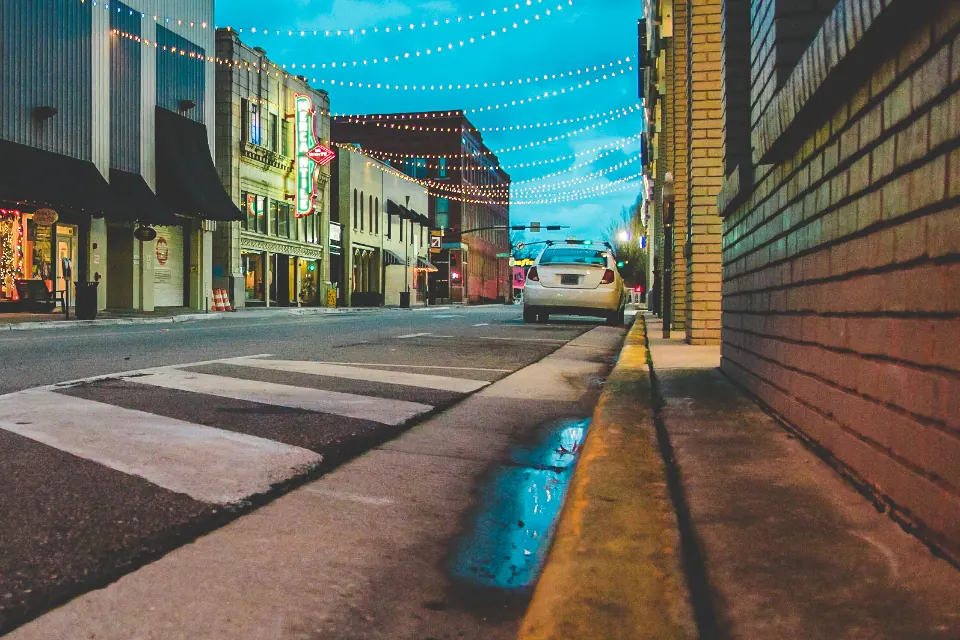
Night drives through Downtown or along Sunset are rich with color. Raise ISO to 3200, open to f/1.8 and use street lights and signal glow as moving key lights.
Lighting inside the car
A parked car is a small, dark studio with a huge window. In daylight, the windshield and side glass act as a soft key from above and in front, and the dashboard bounces warm light under the chin. Often the only addition needed is a small white card on the passenger's lap to open the shadows.
At night, interior light becomes a choice. A small battery LED tucked under the dash, gelled to match street lighting, gives a subtle glow without looking staged. Avoid the car's own dome light; it's usually green and overhead, the least flattering angle there is.
Shooting in from outside at night, the balance is between the face and the city reflected on the glass. Underexpose the reflection a stop, let the interior LED carry the face, and the two layers will separate. Small changes in your position move the reflections a lot, so step left and right before settling on a frame. In car window photography, that half step is often the difference between a busy frame and a clear one.
Editing for print
A sequence of car window photography reads like a road movie when it runs in order. Lay out the edit as a journey: departure, city, a portrait, a long blur, arrival. Keep grain and slight softness; the glass adds both anyway, and cleaning them up removes the feeling of being in the car.
Check smudges and dust on the window before every take. A fingerprint in the wrong place can sit right over an eye.