Women's March Los Angeles and the Ethics of Protest Photography
In January 2017, huge crowds filled Downtown for the Women's March Los Angeles. A look at how to photograph a mass demonstration well, and responsibly.
A crowd that filled downtown
The Women's March Los Angeles, held on January 21, 2017, the day after the presidential inauguration, was one of many sister marches across the country. Crowds gathered around Pershing Square and moved toward City Hall, filling Downtown streets for hours. For photographers, it was a lesson in how to cover an event too big to see from any single spot.
Mass marches are not like smaller protests. There is rarely confrontation, rarely a single focal point and often no way to move freely through the crowd. The story is the scale and the people who make it up: families, first-time marchers, people with homemade signs.
The best coverage combines both. Wide frames that show the size of the event, and close, human frames that show why people came.
Showing scale
Height is everything. A parking structure, a fire escape, a raised plaza or the steps of a public building can turn a sea of heads into a readable image. Scout options the day before, and arrive early, because every other photographer has the same idea.
Compression helps. A 70-200mm from a high point looking down a long street like Broadway or Spring stacks the crowd and the signs into a dense wall. A wide lens from the same spot shows the street in context, with buildings framing the march.
Shoot at intervals. The crowd swells, thins and changes direction through the day. A sequence from the same vantage point shows how the march grew in a way a single frame cannot.
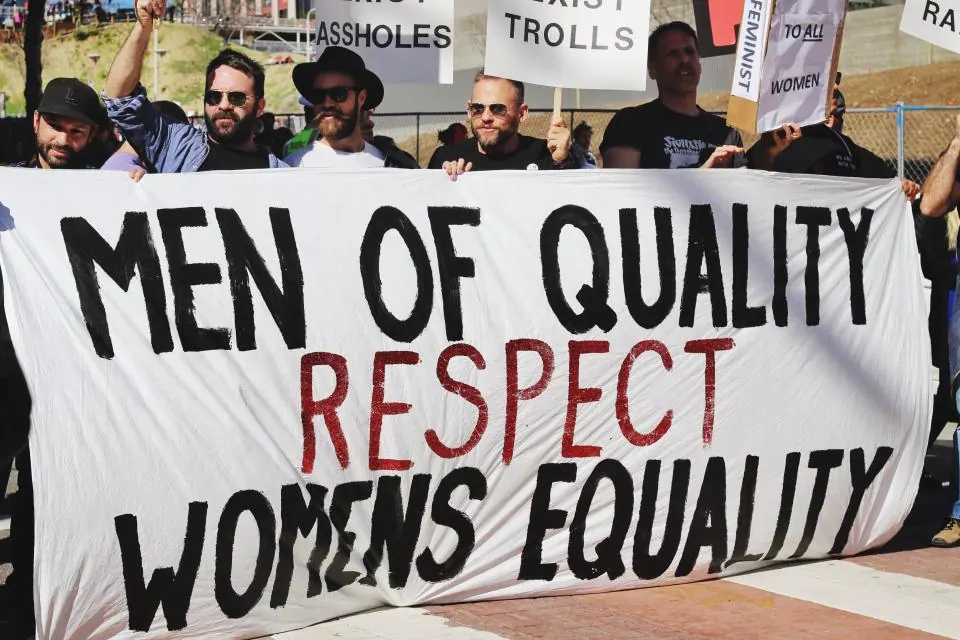
The connection between the words on the sign and the face behind it is the picture.
Signs, faces and small moments
Handmade signs are the visual language of a march, and they can carry a gallery. Look for signs with clear, legible text and a person behind them, not just the sign alone. The connection between the words and the face is what makes the picture.
Get down into the crowd with a 35mm or 28mm lens. Children on shoulders, older marchers who have done this before, friends holding hands, a person resting on a curb. Keep the camera at chest height and work slowly; marchers are generally happy to be photographed if you are open about what you are doing.
Do not forget the edges: vendors, volunteers handing out water, the clean-up crew at the end of the day. The Women's March Los Angeles story includes the logistics as well as the slogans.
The ethics of photographing protest
Protest photography carries real consequences for the people in the frame. Some marchers may face problems at work, with family or with authorities if they are identified. Ask yourself who might be harmed by a face being visible and searchable, especially for vulnerable groups like undocumented people or minors.
Some photographers choose to shoot faces only with consent, use shallow focus or backlight to obscure identity, or favor crowd and sign shots over tight portraits when publishing. None of these is a rule, but each is a decision worth making on purpose rather than by default.
Caption honestly and do not stage anything. Note the date, place and what you saw, avoid guessing at crowd sizes and resist the urge to ask someone to raise a sign again. Documentary work only has value if the viewer can trust it.
Practical safety in a dense crowd
A peaceful march is still a dense crowd. Keep your bag in front of you, carry minimal gear and agree on a meeting point with anyone you came with, since phone networks often slow down when thousands of people are in a few blocks.
Know your exits. If you are working from a raised spot, note how you will get down if the crowd presses in. Keep your press credential, if you have one, visible but not in the way, and follow instructions from police and march marshals.